
How Technical Do Product Managers Really Need to Be ?


Let’s paint a scene.
You’re sitting in a meeting, then an engineer brings up latency issues with the new integration and heads around the table nod in agreement. You nod too, but deep down, you’re not entirely sure what it means.
Or picture yourself in a planning session. Stakeholders are discussing system design trade-offs and suddenly the spotlight shifts; everyone expects you to weigh in. You force a smile to buy a few seconds, and ask a general question — something broad enough to keep the conversation moving but safe enough to hide the fact that you’re unsure. Inside though, you’re wondering: should I know more?
Moments like these can feel uncomfortable, even isolating. And yet, they trigger a question every Product Manager (especially those from non tech backgrounds) eventually asks: how technical do I really need to be to thrive in this role?
There are, of course, Technical PM roles; positions explicitly built for people with coding skills or deep engineering knowledge. But that’s not the reality for most PMs. Which is why the real question isn’t whether PMs should be technical at all, but how technical is enough?
This article unpacks that. Here’s what we’ll cover:
What “technical” really means in the context of product management.
Why expectations vary so much across companies, teams, and products.
The arguments for PMs developing technical skills.
The arguments against going too far into technical detail.
How PMs can build the right level of technical fluency
But before answering how technical a PM should be, let’s start with the basics: what does “technical” even mean?
What Being “Technical” Means for PMs
Ask different people what being “technical” means, and you’ll probably get very different answers.
For some, it’s about coding. Being able to write SQL queries, understand APIs, maybe even ship a small feature yourself. That’s the world of Technical PMs, where deep technical expertise is built into the role.
For others, “technical” simply means fluency; being able to follow conversations about infrastructure, latency, or architecture without looking lost. You may never write a line of code, but you know enough to ask the right questions and make informed trade-offs.
And then, for some PMs, “technical” is just about translation; the ability to bridge the gap between engineers and non-technical stakeholders. You don’t need to know how the system works in detail, but you need to understand it well enough to explain why a delay or limitation matters in business terms.
Even within software teams, expectations shift. A PM working on a payments product might be expected to understand APIs and integration flows, while one leading a data-heavy platform may need more familiarity with data pipelines and analytics tools. A PM in a consumer app may only need enough technical grounding to prioritise features effectively and communicate with engineers.
In other words, “technical” is less of a box to check and more of a spectrum:
At one end, there are Technical PMs; roles designed for those with deep system knowledge and sometimes coding responsibilities.
At the other, there are Business-Oriented PMs; who rely heavily on engineers for technical depth but bring strength in customer empathy, business strategy, and prioritisation.
Most PMs fall somewhere in between, where the goal isn’t mastery but fluency, that is understanding enough of the technology to make smarter decisions and keep teams aligned.
The point here is clear: “technical” is not a binary skillset. It’s a sliding scale, and where you need to land depends heavily on your product, your company, and your team.
So if “technical” can mean so many different things, the next question is obvious: why does it matter at all?
Why Is Being Technical Important?

1. Clearer Communication with Engineers: PMs spend a large part of their time working with engineering teams. When you understand APIs, databases, or system constraints, you don’t need every detail explained to you so you can ask focused and more relevant questions. This makes conversations faster, reduces friction, and shows engineers you respect their domain.
2. Better Trade-Off and Feasibility Decisions: Every product decision involves trade-offs. Should we build or buy? Launch quickly or delay for stability? Invest in scale now or later? A PM with technical fluency can weigh these choices more intelligently. You’re not just asking “can we do this?” but “what’s the cost of doing it this way versus another?”
3. Increased Credibility with Technical Teams: The fact is: engineers sometimes doubt whether PMs “get it.” When you demonstrate technical understanding, even at a high level, it bridges that credibility gap. Engineers are more likely to trust your prioritisation calls if they know you’ve factored in the complexity behind them.
4. More Realistic Roadmaps: Without technical awareness, roadmaps can become wish lists, full of deadlines and deliverables that don’t reflect reality. A technically fluent PM can create timelines that balance ambition with feasibility, making both leadership and engineering more confident in the plan.
5. Stronger Problem-Solving: Not every issue requires coding, but many require technical reasoning. When something breaks in production or performance dips, you may not fix it yourself, but understanding the likely causes helps you respond faster, set the right priorities, and manage stakeholder expectations effectively.
The case for technical fluency is strong. But it’s not the whole story. Some argue that leaning too much into technical skills can actually pull PMs away from what really matters. So let’s look at the other side of things why PMs don’t need to be deeply technical.
Why PMs Don’t Need to Be Deeply Technical

1. Risk of Becoming a “Shadow Engineer”: When PMs go too far into technical details, they can end up second-guessing implementation decisions or stepping into engineering territory. This can frustrate engineers, slow down progress, and blur the lines of responsibility. PMs add more value when they focus on what to build and why, not how to build it.
2. Core PM Skills Matter More: The most important skills for a PM aren’t technical, they’re strategic. Business acumen, customer empathy, prioritisation, storytelling, and stakeholder alignment are some of the skills that drive real product success. A PM who masters these will often outperform one who can code but can’t define a compelling vision or rally a team.
3. Over-Focus on Technical Can Blind You: Products don’t succeed because they’re technically perfect, they succeed because they solve real customer problems. A PM who spends too much time in the weeds risks optimising for elegant solutions that customers may not care about, while overlooking usability, adoption, or business impact.
4. Technical Knowledge Isn’t Universal: Even technical expertise has limits. A PM might understand APIs well, but struggle with machine learning, or know databases but not cloud infrastructure. Expecting PMs to be highly technical across every context sets an impossible standard. That’s why strong teams are built on collaboration, not individual mastery.
5. Hiring Engineers Twice Isn’t Efficient: Companies already invest in engineers for technical depth. If PMs are required to be equally technical, you risk overlap instead of complementarity. The PM role was designed to bridge disciplines, not duplicate them.
Should PMs Know How to Code?

No debate about being technical as a Product Manager is complete without tackling the biggest misconception of all: does being “technical” mean you need to know how to code?
For many outside the field, “technical” and “coding” are used interchangeably. But in practice, they’re not the same thing. Coding is one narrow (and very specific) way of being technical. Technical fluency, on the other hand, is broader; it’s about understanding systems, trade-offs, and implications well enough to make smart product decisions.
When coding helps:
In early-stage startups where PMs wear multiple hats, being able to hack together prototypes or run quick SQL queries can save time and reduce dependencies.
For PMs with engineering backgrounds, coding can sometimes help them empathise with technical challenges more deeply.
For PMs in deeply technical products (developer tools, APIs, infrastructure), some hands-on coding can increase credibility and improve communication
When coding isn’t necessary:
At larger companies with mature engineering teams: your role is to drive strategy, not write code. Engineers already own the “how.”
In customer-facing or growth-heavy products: where success depends more on understanding user behaviour, market dynamics, and adoption than on coding.
When focusing on leadership and influence: as you move into senior PM roles, your ability to align stakeholders and define vision matters more than technical execution.
The takeaway? PMs don’t need to code to succeed. It can be a useful add-on in specific contexts, but it’s not a requirement. Far more important is building enough technical fluency to collaborate with engineers, weigh trade-offs intelligently, and translate between technical and business worlds.
And that brings us to the real answer: if coding isn’t the benchmark, what does it actually mean to be “technical enough” as a PM?
The Middle Ground: Being Technical Enough

Being “technical enough” in practice comes down to a set of core skills, not to make you an engineer, but to give you the fluency to ask better questions, guide smarter trade-offs, and hold your own in technical discussions. These skills sit on the spectrum of technical knowledge: enough to add value and earn credibility, but not so deep that you drift into doing engineering work yourself. They are;
1. Understanding APIs and Integrations
Most modern products rely on APIs to connect with other platforms whether it’s enabling payments, verifying identity, or pulling data from external systems. A PM who’s technical enough doesn’t need to build an API, but should understand:
What an API is and how it works in enabling integrations.
The role of endpoints, authentication, and rate limits in performance
How API failures or latency can impact user experience.
The difference between building in-house vs. leveraging third-party APIs.
What you need to learn: REST API basics, authentication methods like OAuth, JSON/XML data formats, API lifecycle and strategy management, API gateways, API governance and compliance, and hands-on testing with Postman or Swagger.
2. Knowing How Data Works
Data is the lifeblood of most products. You don’t need to design a database, but you should understand enough to have meaningful conversations with data engineers and analysts. This means:
Grasping the difference between relational (SQL) and non-relational (NoSQL) databases.
Knowing how data is structured, stored, and retrieved.
Understanding the flow of data from collection to reporting (pipelines, ETL).
Being able to query or at least interpret data to validate product hypotheses.
What you need to learn: SQL fundamentals, schemas, indexes, data normalisation, caching strategies, partitioning/sharding, load balancing, and cloud-based tooling (AWS, GCP, Azure) for scalable data systems.
3. Grasping System Trade-Offs
Every product decision has technical implications. As a PM, you don’t need to decide how to implement, but you should understand enough to weigh trade-offs. This includes:
Recognising what “technical debt” is and how it impacts velocity later.
Knowing when scalability matters (e.g., 10k vs. 1M users).
Understanding why latency or downtime matters for customer trust.
Balancing quick wins with long-term maintainability.
What you need to learn: basics of system architecture (front-end vs. back-end, client vs. server), monoliths vs. microservices, system design patterns, integration strategies, APIs in system integration, and cloud infrastructure essentials.
4. Communicating Across Worlds
One of your biggest responsibilities as a PM is acting as a translator. Engineers, designers, and business stakeholders all think differently, and you need to bridge that gap. To do this well, you should:
Break down complex technical topics into simple business impact statements.
Help stakeholders understand why a technical limitation matters.
Ensure engineers understand the why behind business priorities without drowning them in jargon.
Keep everyone aligned on trade-offs and outcomes.
What you need to learn: requirement gathering and analysis, system design fundamentals, key diagramming techniques (Lucidchart, Miro, Whimsical), storytelling frameworks, and writing clear user stories with acceptance criteria.
5. Using the Right Tools
Being technical enough also shows up in the tools you use. You may not be in the codebase, but you can still leverage tools that give you visibility into technical processes and customer experience. This includes:
Testing APIs with Postman or Swagger.
Sketching systems flows to clarify architecture.
Running SQL queries for product metrics.
Navigating Jira to understand dependencies.
Using monitoring dashboards/logging tools to spot issues.
What you need to learn: Postman for API testing, Swagger/OpenAPI docs, SQL basics, Jira for backlog management, GitHub navigation, diagramming tools for system mapping, plus software testing fundamentals (types of testing, frameworks, creating and executing test cases).
Now, You won’t need all of these skills at once, and not every role demands the same level of technical depth. Some PMs only ever need a working foundation while others, especially in technical or infrastructure-focused roles, may need to go much further.
That’s the point: technical fluency exists on a spectrum. It’s about knowing enough to be effective without going overboard into engineering. And the level you need depends on your product, your team, and the stage of your career.
To make this easier to visualise, here’s a simple breakdown of the levels of technical fluency.
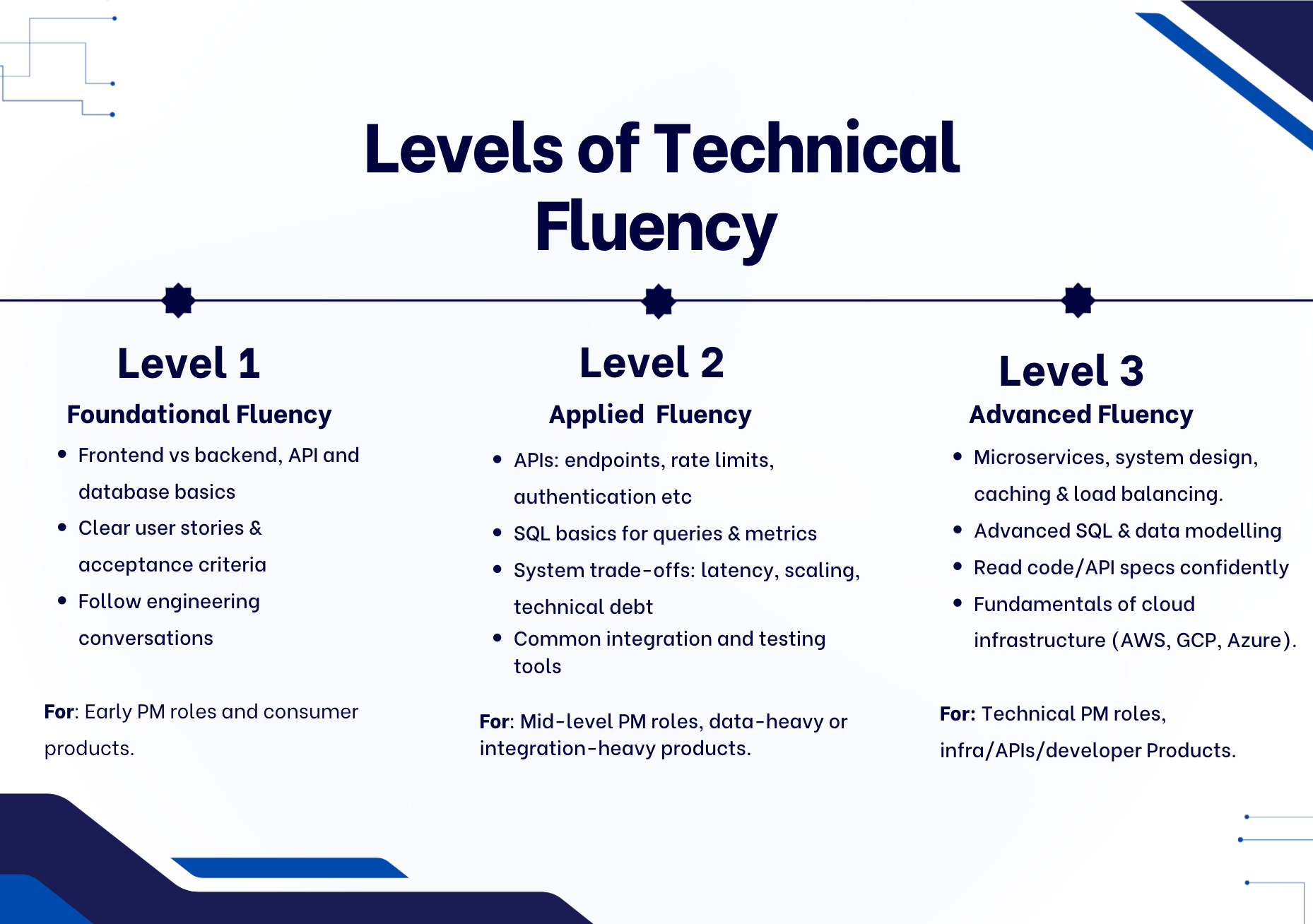
So, how technical should a PM be? The answer isn’t fixed, it varies depending on with the product, the team, and the stage you’re working in. What stays constant is the need for fluency: enough understanding to ask sharper questions, weigh trade-offs with confidence, and keep teams aligned without creating friction.
The heart of product management has always been about clarity and alignment. Technical knowledge doesn’t replace that, it enhances it. It’s one more way to guide conversations, build trust with engineers, and make decisions that hold up under both business and technical scrutiny.
See you next week for another breakdown!

Wow.... I love the breakdown and this gave me a direction with my technical needs as a PM because it helps us understand limitations from the view of an Engineer when there's one especially in start ups where we have to wear the hat of a project manager